
AEO GEO Tips: Boost SMB Visibility with AI
AEO GEO Recommendations, SMB Visibility Tracking, AI Citation Analysis
AEO GEO Recommendations for SMBs: How to Be Chosen by AI, Not Just Searched
As AI-driven search and assistants become the default discovery layer, small and medium-sized businesses must adapt. AEO GEO (AI Engine Optimization and Geographic Optimization) is about ensuring your business is visible, trusted, and frequently cited when AI tools answer local, commercial, and informational queries. The following AEO GEO Recommendations focus on practical steps professionals can implement to strengthen SMB visibility, improve AI citations, and future-proof local SEO efforts.
1. Start with SMB Visibility Tracking in AEO GEO
You cannot improve what you do not measure. Effective SMB Visibility Tracking for AEO GEO begins with understanding how often, and where, your business appears when people use AI assistants and local search. Monitor three layers of visibility:
Classic local search: rankings in Google Maps, Apple Maps, and local packs for core keywords and service areas.
AI overviews and summaries: how often your brand or domain is cited in AI-generated result panels and answer boxes.
Assistant responses: whether tools like Google Assistant, Siri, Alexa, and emerging AI agents mention or recommend your business for relevant queries.
Track branded and non-branded queries, monitor impressions, and log when AI systems choose competitors over you. This baseline will guide your AEO GEO strategy and help you prioritise markets and services.
2. Listen to What People Are Talking About Locally and in AI
AEO GEO is driven by real conversations. You need to understand what people are talking about in your category and geography. Combine social listening, review monitoring, and AI prompt testing:
Analyse reviews, support tickets, and social comments to identify recurring questions, objections, and praise points.
Ask AI tools the same questions your customers ask (for example, “best accountant near me for startups”) and note which topics and features they emphasise.
This intelligence should shape your content, on-page messaging, and review strategy so that you align with real demand, not internal assumptions.
3. Understand What Kind of Business AI Elements Are Citing
AI Citation Analysis is critical. When AI overviews, local packs, or assistants answer a query, examine what kind of business they highlight:
Are they citing well-structured websites with clear Schema Markup and complete business profiles?
Do they favour brands with strong review volume and recency in your GEO?
Are thought-leadership articles, how-to guides, or FAQs being quoted directly?
In 2026, studies show that pages with comprehensive schema stacks and strong entity signals are significantly more likely to be cited in AI overviews than those without structured data. Understanding these patterns allows you to reverse-engineer what AI systems perceive as “trusted local authority” and position your SMB accordingly.
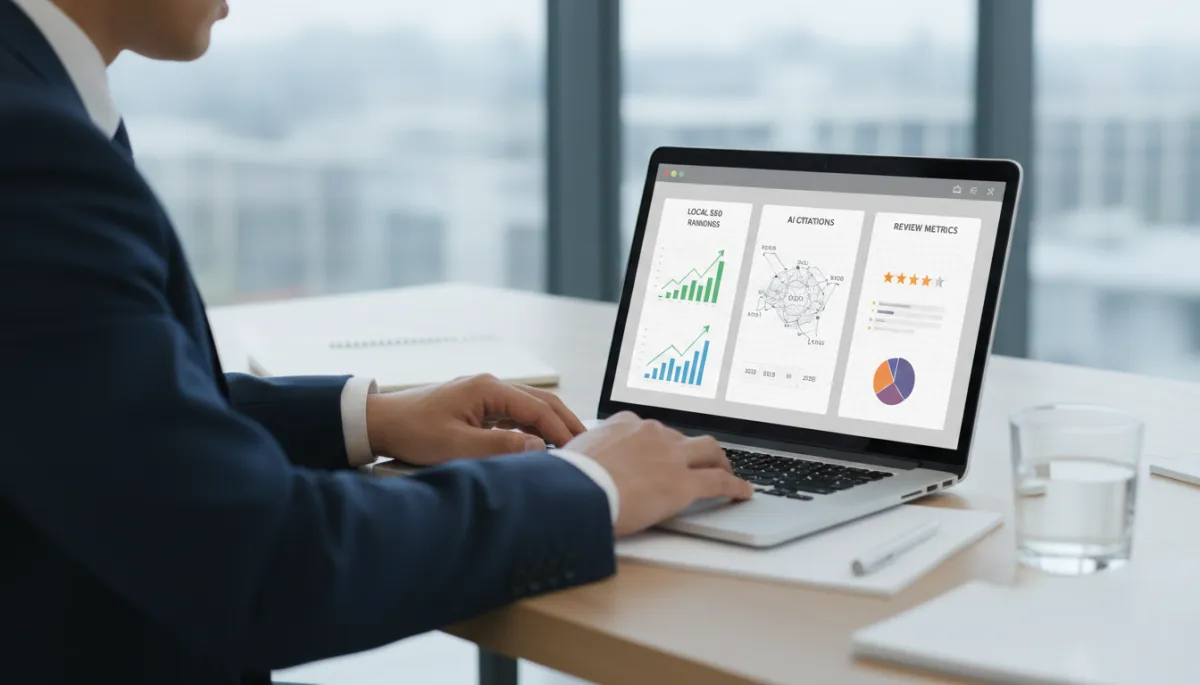
Unified tracking of search, AI citations, and reviews reveals the real drivers of visibility.
4. Core Actions SMBs Can Take to Improve AEO GEO
Once you understand the landscape, you can move from insight to action. At a high level, SMBs should:
Standardise NAP (name, address, phone) and category data across all listings and directories in your GEO.
Build a content and review strategy around the questions customers and AI tools keep repeating.
Implement foundational Schema Markup and validate it regularly.
5. Make Your SEO “AI-Ready” with Strong Technical Foundations
Traditional SEO remains the backbone of AEO GEO. Fast, crawlable, secure sites are easier for both search engines and AI systems to understand and trust. Focus on:
Clean site architecture, logical internal linking, and descriptive URL structures.
Mobile performance and Core Web Vitals, especially for location pages and high-intent content.
Clear on-page optimisation: title tags, meta descriptions, H1s, and copy that reflect how people actually search in your GEO.
These steps make your SEO good in the classic sense and provide structured signals that AI systems can rely on when selecting references.
6. Schema Markup: The Structured Backbone of AEO GEO
Schema Markup is now a visibility driver for AI, not just a nice-to-have for rich snippets. For most SMBs, a practical schema stack includes:
Organization or LocalBusiness schema: to clarify your entity, location, contact details, and sameAs profiles.
WebSite and BreadcrumbList: to help AI understand site structure and key sections.
Product or Service schema: for core offerings, including pricing, availability, and benefits where appropriate.
Review and AggregateRating: to connect real customer sentiment to your entity and offers.
Implement schema in JSON-LD, validate using Google’s Rich Results Test and the Schema.org validator, and keep it updated as your business evolves. This structured layer makes it easier for AI to extract and attribute your information accurately, increasing the odds of better AEO GEO references.
7. Prioritise Original Content Focus Over AI-Generated Noise
AI systems increasingly discount generic, derivative content. To stand out, your Original Content Focus must be clear. Create pieces that:
Answer specific local questions with data, examples, and insights unique to your business and geography.
Include case studies, pricing explanations, and process breakdowns that generic AI content cannot easily replicate.
Original, well-structured content is more likely to be quoted directly in AI overviews and cited as an authoritative source for your niche.
8. Reviews, Feedback, and Social Proof as AEO GEO Fuel
Reviews and feedback are no longer just conversion assets; they are core ranking and citation signals. Focus on:
Growing review volume and recency on Google Business Profiles, key vertical platforms, and trusted local directories.
Encouraging customers to mention specific services, locations, and outcomes in their feedback, which AI can parse and summarise.
Responding professionally to both positive and negative reviews, signalling reliability and active management.
Structured review data, combined with schema, strengthens your reputation signals and supports more favourable AI-generated mentions.
9. Backlink Strategies that Support Better AEO GEO References
Backlinks remain one of the clearest indicators of authority for both search engines and AI systems. Effective Backlink Strategies for AEO GEO emphasise:
High-quality local citations from chambers of commerce, industry associations, and reputable local media.
Thought-leadership contributions to niche blogs, trade publications, and partner sites that mention your brand and GEO.
Co-marketing campaigns that generate both referral traffic and contextual backlinks to your key location and service pages.
These signals help AI distinguish your business as a trusted local authority, increasing the likelihood of favourable AEO GEO references when it compiles answers.
10. Bringing It All Together: AEO GEO as an Ongoing Discipline
For SMBs, AEO GEO is not a one-off project but an ongoing discipline that blends SMB Visibility Tracking, AI Citation Analysis, Schema Markup, Original Content Focus, review management, and Backlink Strategies. The businesses that will win in 2026 and beyond are those that treat AI and local search as a single, integrated ecosystem, continually monitoring how they are referenced and taking deliberate steps to become the obvious, trusted answer in their market.
